
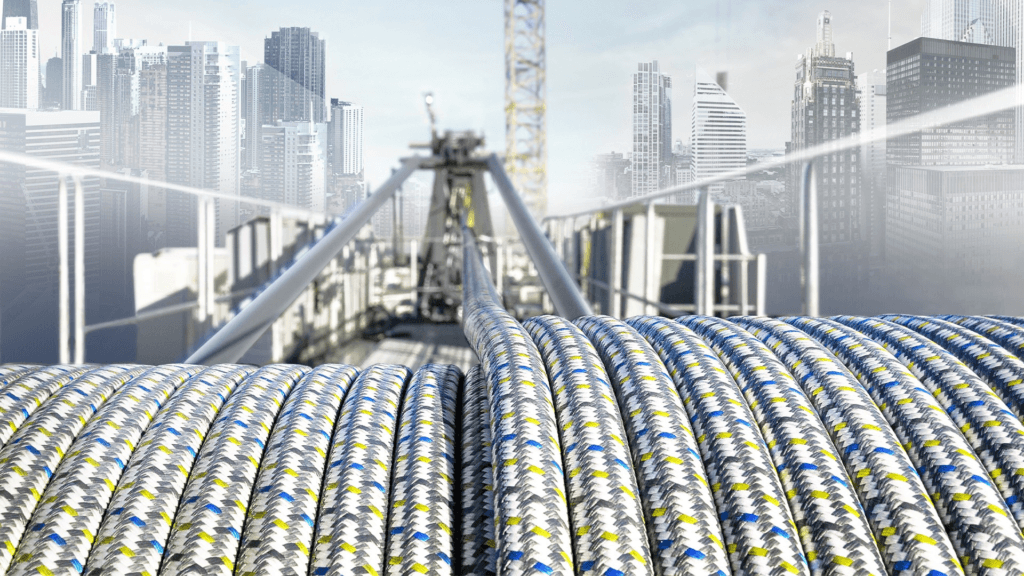
In the tower crane and heavy lifting industry, any breakthrough in materials technology tends to draw widespread attention. A few years ago, Liebherr broke with decades of convention by introducing high-tech fibre rope to replace conventional steel wire rope, formally naming the product line built around this system the “Fibre Rope Crane” series. When the concept first emerged, many in the industry probably had the same instinctive reaction: isn’t it just swapping out a rope? Can’t you simply buy one and wind it onto an existing hoist drum? Was a whole new product series really necessary? Yet once you dig deeper into the technology and work through the underlying engineering principles, it becomes clear that fibre rope is not a drop-in replacement — it represents a fundamental restructuring of the entire hoisting system.
1. The Dead Weight Problem with Steel Wire Rope
To understand why manufacturers are pushing so hard on fibre rope, it helps to start with some straightforward physical data. Take a standard 12-tonne tower crane: to meet tensile strength requirements, it typically comes fitted with 14mm high-strength steel wire rope. On a high-rise project, 500 metres of that rope weighs around 400 kilograms. On super-tall projects requiring over a thousand metres of rope, or on heavy-duty cranes using thicker rope, the total rope weight can easily reach several tonnes. In crane mechanics, this suspended rope mass is pure dead weight, directly eating into the crane’s rated lifting capacity. At maximum radius, where usable load is already limited, rope self-weight becomes a hard constraint on performance. Switching to fibre rope reduces rope weight by approximately 80%, freeing up the payload headroom that dead weight had been consuming — though the actual improvement in lifting capacity also depends on structural strength, reeving ratio, and other factors.
2. Why Fibre Rope Requires Dedicated Components
If the weight advantage is so significant, why hasn’t fibre rope taken over the market? The answer is not that the entire crane needs to be redesigned from scratch. Liebherr’s Fibre Rope Crane shares the vast majority of its structure with the equivalent steel rope model — the most cost-intensive tower sections and substructures are fully interchangeable, and it is even possible to convert a fibre rope crane back to steel rope if needed.
The components that require dedicated engineering are just three: the hoist drum, the rope pulleys, and the hook block.
But the technical demands on these three parts are exceptionally high. Under tension, synthetic fibre tends to flatten in cross-section. The tight multi-layer winding of a conventional V-groove drum generates intense internal friction and heat that would destroy fibre rope in very little time. To address this, Liebherr developed wide-groove sheaves with custom synthetic coatings, a hoist drum specifically engineered for the physical properties of fibre rope, and sophisticated multi-layer spooling control algorithms. This core system must function as a precisely integrated whole — any shortfall in any one component risks rapid rope failure.
In other words, the barrier to widespread adoption is not that the whole machine needs reinventing. It is that these three critical components demand an extraordinarily high level of engineering expertise and carry significant development costs. For now, only the leading manufacturers have the capability to bring them to reliable, production-ready quality.
3. Performance Comparison: Fibre Rope vs. Steel Wire Rope
Key advantages:
Reduced dead weight, increased usable payload: With rope self-weight cut by around 80%, the load margin previously absorbed by the rope is freed up on super-tall and long-radius applications, improving practical lifting efficiency.
Significantly lower maintenance requirements and visual service life indicator: Fibre rope does not rust and requires no lubrication, substantially reducing routine maintenance and eliminating the grease contamination that affects equipment and workers on steel rope cranes. Liebherr’s fibre rope incorporates a red signal layer that becomes visible as the outer layer wears — readable even from a distance — directly addressing the longstanding blind spot of hidden internal wire breaks in steel rope that are difficult to detect before failure.
On-site repairability: Fibre rope offers a degree of on-site repairability that steel rope cannot match. Minor damage can typically be addressed quickly on site using a dedicated repair kit, which is a clear practical advantage in the field.
Lower replacement labour cost: Fibre rope is light enough for two or three workers to handle without heavy equipment. Replacement takes significantly less time, reducing both labour costs and crane downtime.
Current limitations:
High upfront cost: Initial purchase price is several times that of steel wire rope, and the system requires the additional investment in dedicated hoist components, making the overall entry cost substantial.
Poor heat resistance: Steel wire rope is virtually immune to the welding sparks and cutting debris common on construction sites. Fibre rope, being a polymer material, is highly sensitive to heat. A localised burn from a welding spark can trigger thermal degradation or melting of the polymer chains, causing a sharp localised drop in tensile strength. This places demanding requirements on on-site protection and handling practices.
Supply chain vulnerability: Given the high cost of fibre rope, no rental company or contractor will keep a spare length on site. If damage exceeds what can be repaired in the field, the lead time through global supply chains and the manufacturer’s response time could bring a project to an uncontrolled standstill — a very different situation from conventional steel wire rope, which can typically be sourced locally within hours in most cities.
4. Residual Value and End-of-Life Realities
For equipment managers and project contractors, whole-life cost accounting is an important part of any investment decision.
Fibre rope does offer meaningful flexibility when it comes to damage management: minor damage can be repaired on site, and more severely affected sections can be shortened and continue in use, much as with steel rope. However, the two materials diverge significantly at end of life. Steel wire rope can be sold for scrap by weight, recovering some residual value. Fibre rope, due to its material composition, cannot be smelted or recycled through conventional metal recovery channels, and there is no secondary scrap market for it. Its residual value at end of life is effectively zero.
This means that in any total cost of ownership (TCO) calculation, the high initial purchase price of fibre rope cannot be partially offset by residual value at retirement. The full cost must be absorbed over the rope’s working life. For budget-conscious contractors or those working on shorter projects, this is a financial reality that cannot be ignored.
5. The Industry Logic Behind Luffing Jibs, Internal Climbing, and Fibre Rope
Looking back at the history of construction machinery, new crane configurations have almost always been driven by necessity: the luffing jib crane emerged from the pressures of dense urban sites; the internal climbing crane from the prohibitive cost of external attachment systems on super-tall buildings. So will fibre rope eventually follow the same path to widespread adoption?
Because fibre rope requires a set of dedicated components involving precise mechanical engineering and electronic control algorithms, mass adoption will not come easily. The development threshold is high and the cost of iteration is significant. For the foreseeable future, this technology will likely be driven forward primarily by the leading manufacturers — Liebherr, Zoomlion, XCMG and others — as a flagship offering. The current barriers of high cost, vulnerability to heat, demanding site protection requirements, and long supply chain lead times remain real, and for now fibre rope remains a configuration reserved for a limited number of high-end specialist applications.
Yet advances in technology have a way of arriving faster than anyone expects. No one can say when the inflection point in fibre rope’s development and cost trajectory will come — maybe tomorrow. It’s just a matter of time, I think.